Next to the price on the brochure is a green label that says USDA Certified Biobased. It looks official, and it is. It just may not mean what you think.
Here’s the short version. The label tells you how much of a product comes from plants and other renewable sources. A lab measures that with a test called ASTM D6866. It’s a content label, not a safety or performance approval. We’d rather you hear that from us than find it out later.
What the USDA label measures
The label comes from USDA’s BioPreferred program. USDA says the label “assures a consumer that the product contains a verified amount of renewable biological ingredients.” You can see how the program works in the USDA BioPreferred FAQ.
Verified how? With ASTM D6866. That lab test measures the renewable carbon in a product, meaning the carbon that came from plants and other living things. The result is a percent. For products that don’t fit one of USDA’s set categories, the minimum is 30 percent. So two products can both carry the label with very different numbers behind it. If you want the number, ask to see the label or the certificate. And look for the exact words USDA Certified Biobased Product. The word bio-based on its own isn’t the label.
What the label doesn’t tell you
USDA says this part out loud. More renewable carbon “does not necessarily indicate superior performance, safety, or environmental impact.” So the label can’t tell you how long a treatment holds up on a roof in Spring. It isn’t a stamp of approval on safety either. It’s one fact about what’s inside, checked by a lab.
That’s why we never use the label as proof the treatment works. For that, look at what a company will put in writing. Bright Green Roof backs the treated shingle with a 5-year transferable warranty that it stays pliable and flexible. That’s a promise you can hold someone to. A content label was never meant to be one.
Why a dry shingle needs oil
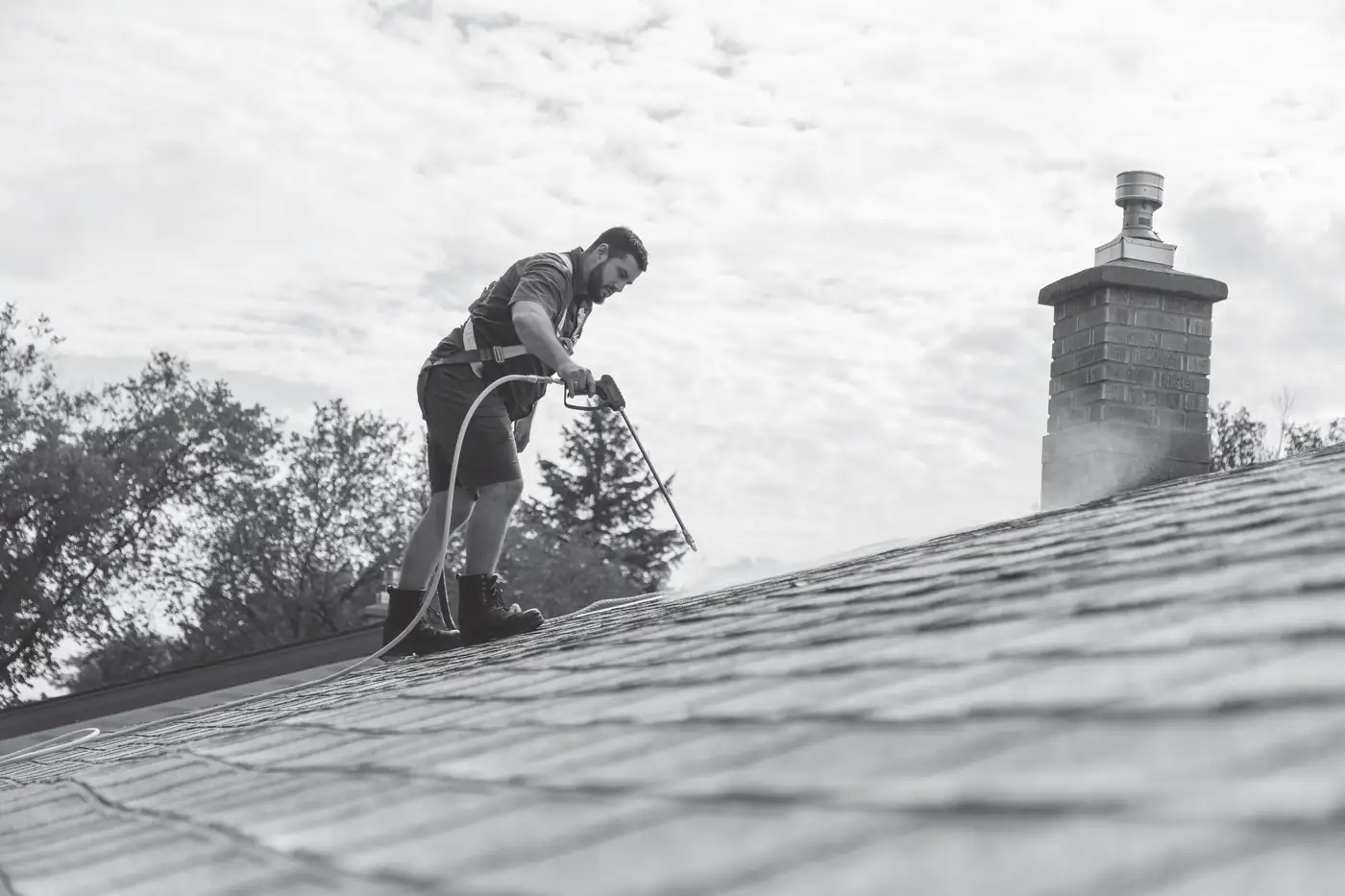
A new asphalt shingle is full of light oils. That’s what lets it bend. Then the sun goes to work. Heat and UV bake those oils out, year after year. The shingle dries out and gets stiff. Stiff shingles crack, curl at the edges and shed granules into the gutter.
Our summers speed that up. At Houston’s IAH airport, the 1991 to 2020 normals show about 102 days a year at 90 degrees or hotter. The UV index averages 10.3 in June. That’s what your roof sits in every summer.
Bright Green Roof says its treatment is made to “replenish the bitumen within the asphalt shingle.” Bitumen is the asphalt itself. The plant-based oil soaks into the dried-out shingle and restores its flexibility. The goal is to do that while the shingle is still worth saving. Our page on how roof rejuvenation works walks through each step, from the cleaning to the spray.
What 100% active means
Bright Green Roof calls its product 100% active. That means it isn’t mixed with water. What goes on your roof is all treatment.
Why should you care? You know what you’re paying for. And Chris says it’s how we keep our price per square foot down. We charge $1.00 to $1.50 per square foot of roof, with the cleaning included. Your exact number gets set after the free assessment.
Some products are water-based by design. That’s their call. Your call is to ask any company how much of what they spray is active product. We line up the other brands, using their own published claims, on our page about Roof Maxx and the other roof treatments.
Not a coating, a paint or a sealant
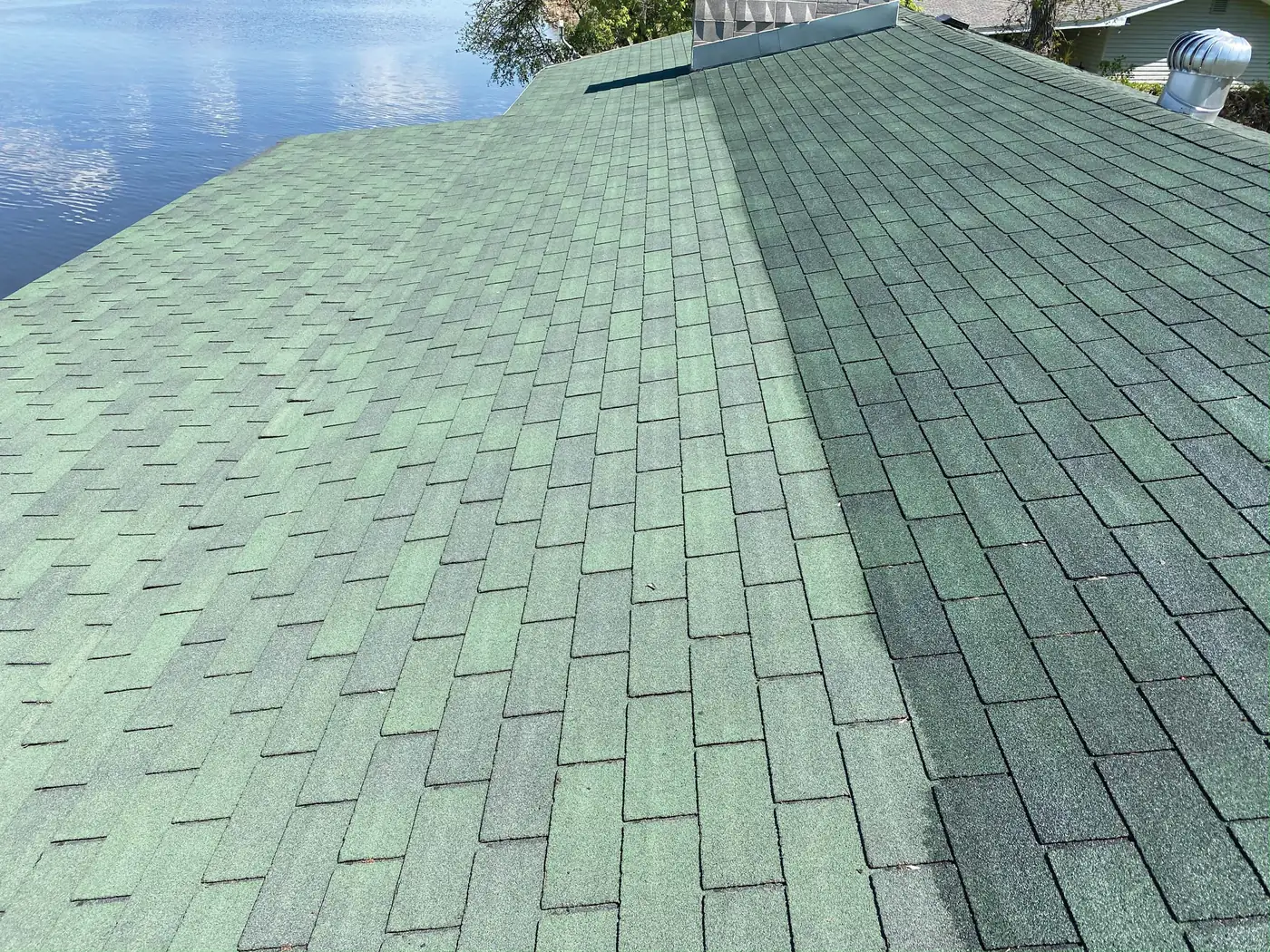
The treatment is a penetrant. It soaks into the shingle. A coating does the opposite. It dries on top as a layer. Paint covers the color, and a sealant fills seams. Bright Green Roof is none of those.
Why does that matter to you? A penetrant works inside the shingle, so there’s no film on top to wear through. It also can’t cover up a problem. A cracked shingle is still cracked after treatment, and it’ll show in the photos.
Here’s what it won’t do. It will not fix a leak. It won’t glue down a missing shingle. It won’t put back granules that already washed away. If your roof needs any of that, Chris will tell you, and he’ll point you to a roofer.
Where to go from here
Chris looked at the options before he chose this product. He explains his reasons on why we use Bright Green Roof. For the whole service, start with roof rejuvenation.
Want to know if your roof is worth treating at all? Book a free roof inspection. Chris photographs every slope and sends you the pictures. If your roof isn’t a candidate, he tells you so, free. That’s the Straight Answer Promise. Or call or text (281) 466-7436.
Common questions
Does USDA Certified Biobased mean the treatment was tested on roofs?
No. The label is about what’s in the product, not how it performs on a roof. A lab measures the biobased content with ASTM D6866, and USDA says more renewable carbon doesn’t by itself mean better performance. For performance, read the written warranty. Bright Green Roof’s covers flexibility for five years, and it transfers if you sell the house.
Is 100% active the same as 100% biobased?
No. They’re two different numbers. 100% active means the product isn’t mixed with water. The biobased percent is the share of the product’s carbon that’s renewable, as measured by ASTM D6866. Ask to see the biobased percent on the USDA label or the certificate. Don’t let anyone blur the two together.
How many times can a roof get the treatment?
Bright Green Roof says its product can be applied to a roof up to three times over the roof’s life. It rates each application for up to ten years. The written warranty is shorter at five years, and it covers the shingle staying pliable and flexible. Whether your roof gets a second round depends on what the photos show when we check it.